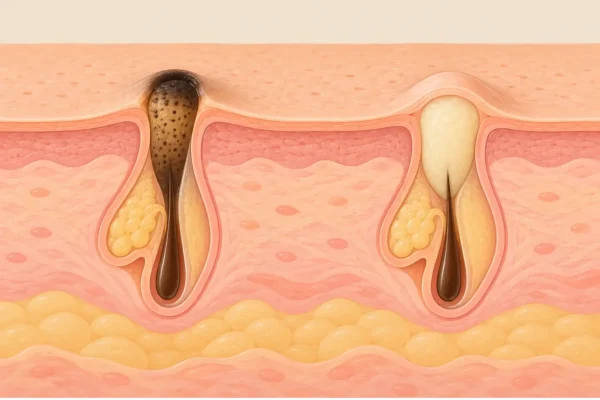
Blackheads and whiteheads begin with the same type of clog.
Oil and shed skin cells collect inside a hair follicle and form a plug. If the follicle stays open at the surface, the clog becomes a blackhead. If the opening is covered, it becomes a whitehead.
That one difference changes how the clog looks and what is likely to help.
How the Clog Begins
Sebum normally travels through the hair follicle and onto the surface of the skin. Skin cells also shed inside the follicle and usually leave without causing a problem.
When those cells begin collecting instead, they can mix with sebum and form a small plug. The earliest stage is too small to see. As more material collects, the clog becomes visible as a blackhead or whitehead.
Because the buildup begins inside the follicle, it cannot be washed away like dirt sitting on the surface.
What Is a Blackhead?
A blackhead is a clogged follicle that remains open at the surface.
The material near the opening is exposed to air and begins to oxidize. This causes the top of the clog to darken.
The dark color is not dirt.
Blackheads may look black, brown, or gray. Some sit almost flat against the skin, while others feel slightly raised. You can usually see a dark center where the follicle remains open.
Scrubbing the surface may remove some oil from the skin, but it does not clear the material extending farther into the follicle.
What Is a Whitehead?
A whitehead is a clogged follicle with an opening that is covered by a thin layer of skin.
Since the contents are not exposed to air, they do not darken. The bump may look white, cream-colored, or the same color as the surrounding skin.
Whiteheads often feel like small, firm bumps beneath the surface. They may appear alone or in groups that make an area feel uneven.
Unlike a blackhead, there is no exposed center for a pore strip to grab or for the contents to leave through easily. Blackheads and whiteheads are therefore known as open and closed comedones.
Not Every Dark Dot Is a Blackhead
Many of the small dots across the nose are sebaceous filaments rather than blackheads.
Sebaceous filaments are normal collections of sebum and shed skin cells inside the follicle. They are usually small, flat, evenly spaced, and lighter than blackheads. They may look gray, tan, or yellowish and are especially noticeable across the nose and chin.
Blackheads are usually darker and less evenly distributed. One pore may contain a visible blackhead while the surrounding pores do not.
Sebaceous filaments refill after they are removed because the follicle continues producing sebum. That is why the nose can look clearer after squeezing or using a pore strip, only for the dots to return soon afterward.
They can sometimes be made less noticeable, but they cannot be permanently removed.
Not Every White Bump Is a Whitehead
Milia are often mistaken for whiteheads because both can appear as small pale bumps.
Milia are tiny cysts filled with keratin. They are not acne clogs.
They usually feel harder than whiteheads and often have a pearly white appearance. They commonly develop around the eyes, upper cheeks, and forehead, although they can appear elsewhere.
A whitehead forms from sebum and skin cells collecting inside a follicle. Milia form when keratin becomes trapped beneath the surface. Because they are not the same type of bump, a product used for clogged pores may do very little for milia.
Trying to squeeze one can leave the surrounding skin sore or damaged without removing it.
A Whitehead Is Not an Inflamed Pimple
The word whitehead is sometimes used for any blemish with a pale center, but a closed whitehead and an inflamed pimple are different.
A whitehead is usually firm and does not have much redness around it.
An inflamed pimple may be red, swollen, tender, or filled with visible fluid. At that point, the follicle is no longer dealing with a clog alone. Inflammation has developed around it.
This matters when choosing what to use. A spot treatment intended for an active inflamed blemish may do very little for a firm closed whitehead. It may dry the surface without changing the plug underneath.
Why Blackheads and Whiteheads Respond Differently
A blackhead has an exposed opening, so part of the visible material can be lifted from the surface. This is why pore strips can make blackheads look less noticeable right away.
The result is temporary. Removing the exposed part does not stop oil and skin cells from collecting inside the same follicle again.
Salicylic acid is often used for blackheads and whiteheads because it can work through the oily buildup inside the follicle.
Whiteheads are covered by a thin layer of skin, so pore strips cannot remove them in the same way. Treatment is aimed at keeping more oil and shed skin cells from collecting inside the follicle.
Why Some Clogs Become Inflamed
A blackhead or whitehead can remain unchanged for a while without becoming red or painful.
Inflammation can develop when pressure builds inside the follicle or the follicle wall becomes damaged. Some of the contents can then move into the surrounding skin, leading to redness, swelling, and tenderness.
Pressing hard on a closed whitehead can make this more likely. Even when nothing comes out, the pressure can damage the follicle beneath the surface and leave the area more swollen the next day.
This is also why a small clog can become a much larger blemish after repeated picking.
How to Tell Them Apart
The first step is knowing what you are looking at.
A blackhead is an open clog with a darkened surface.
A whitehead is a closed clog beneath a thin layer of skin.
A sebaceous filament is a normal collection of oil and skin cells within a follicle.
Milia are keratin-filled cysts, not acne.
An inflamed pimple has redness, swelling, or tenderness that is not usually present with a simple blackhead or whitehead.
Treating all five as though they are the same can leave you using the wrong product or repeatedly trying to remove something that will naturally return.
The Bottom Line
Blackheads and whiteheads contain the same basic material. The difference is whether the follicle opening remains exposed or becomes covered.
That difference explains why blackheads darken, why whiteheads remain pale, and why the two do not respond exactly the same way.
It also helps you avoid confusing normal sebaceous filaments with blackheads, milia with whiteheads, or an inflamed pimple with a closed clog.
Once you know which type of bump you are dealing with, it becomes much easier to decide what is worth treating and what should be left alone.