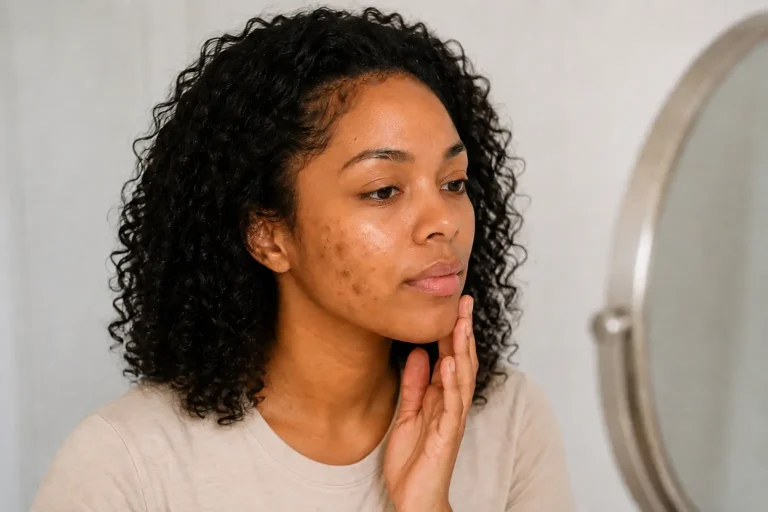
Breaking out in your forties or fifties can be especially confusing when your skin is also becoming drier.
You may notice tender bumps around your chin or jaw while your cheeks feel rougher than they used to. Products that once worked well may suddenly feel too strong, yet the blemishes continue returning.
These changes often begin during perimenopause, the years leading up to menopause.
Why Acne Can Begin During Perimenopause
During perimenopause, estrogen and progesterone begin to fluctuate. As estrogen declines, androgens can have a greater influence on the oil glands even when testosterone levels are not unusually high.
Some women begin breaking out after years of relatively clear skin. Others notice that the acne they already had becomes deeper or appears more often around the lower face.
What Menopause Acne Can Look Like
You may notice:
- Deep, tender bumps around the chin or jaw
- Blemishes that return to the same area
- Closed bumps that remain beneath the surface
- A few painful breakouts rather than many small pimples
- Dark marks that remain after the swelling is gone
These bumps may stay sore for several days without developing a visible center.
Repeatedly applying a drying treatment can leave the surface flaky while the bump beneath it remains unchanged.
Why Your Skin Can Feel Dry and Still Break Out
Oil production often decreases with age, but that does not mean every part of the face changes in the same way.
Your cheeks may become drier while follicles around the chin and jaw remain more responsive to hormonal changes.
Treating your entire face as though it is still very oily can leave clear areas dry without preventing the next lower-face breakout.
Your Old Acne Routine May Need to Change
A routine that worked when your skin produced more oil may now be too drying.
That does not mean you need to replace everything. You may need to change where you apply a product or how often you use it.
If the breakouts are limited to your chin and jaw, keep the treatment in those areas instead of spreading it across clear skin. If the surrounding skin begins peeling or feeling sore, use the product less often rather than adding more products to correct the dryness.
Your routine should fit what your skin is doing now.
Deep Bumps Are Different From Surface Pimples
A deep bump does not always respond to a product made for a surface blemish with a visible white center.
Because the inflammation is developing beneath the surface, repeatedly layering a drying treatment may irritate the skin without flattening the bump.
Avoid pressing on it to see whether anything will come out. Deep blemishes may not have an opening, and squeezing can increase the swelling and leave a post-acne mark behind.
If you use a spot treatment, apply only a small amount. Do not keep adding more throughout the day when nothing is happening at the surface.
Moisturize According to the Area
You do not have to apply the same amount of moisturizer everywhere.
Your cheeks may need a fuller layer, while your chin and jaw may need less.
Pay Attention to Recent Changes
Hormonal changes are a major reason acne can appear during perimenopause and menopause, but timing can still help you understand a sudden change.
Think about whether the breakouts began after starting a new supplement, hormone product, or skincare product. A change happening at the same time does not prove that it caused the acne, but it gives you something specific to review.
You do not need to track every detail of your day. Write down what changed before the breakouts increased and whether the acne improved or worsened afterward.
What Improvement Can Look Like
Improvement may first show up as:
- Fewer deep bumps
- Less soreness
- Blemishes that flatten sooner
- Longer periods between breakouts
- Fewer dark marks afterward
The first change may not be the complete disappearance of acne. A shorter, less painful breakout is still a sign that what you are doing is helping.
Care for the Skin You Have Now
Menopause acne often involves lower-face breakouts at the same time that other areas are becoming drier.
Treat the areas that are breaking out without drying the rest of your face. Use strong products only as often as your skin can handle them, and avoid forcing deep bumps that have no visible opening.
The routine that worked years ago may need to change because your skin has changed too.