Plant oils are often grouped together as though they all do the same thing.
They do not.
Some oils feel light and spread quickly. Others are thicker, more aromatic, or better suited to small amounts. They also differ in freshness, stability, and the way they affect the texture of a finished product.
When I choose an oil for acne-prone skin, I begin with the job it needs to perform. Does the formula need a lightweight base, more slip, added softness, or a richer oil for targeted use?
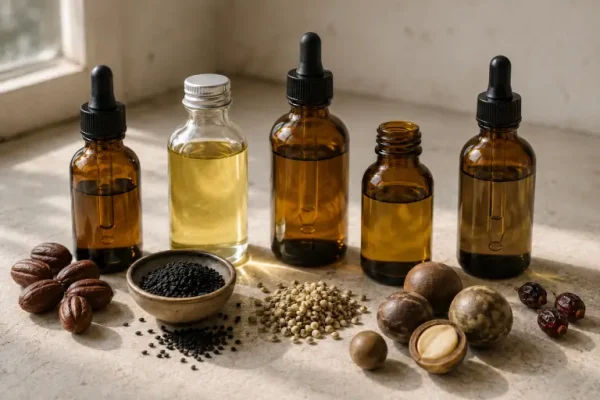
The five oils I return to most often are grapeseed oil, jojoba oil, hemp seed oil, black cumin seed oil, and tamanu oil. I do not use them interchangeably. Each one brings something different to a formula.
Grapeseed Oil
Grapeseed oil is one of the lightest oils I use.
It has a thin texture, spreads easily, and works well as the main oil in a blend. It softens the skin without giving the finished product an overly rich feel.
Grapeseed oil contains a high amount of linoleic acid, one of the fatty acids found in the skin’s surface oils. This fatty acid profile is one reason grapeseed oil is often chosen for oily and acne-prone skin.
Grapeseed oil works especially well as a base because it gives me room to add smaller amounts of richer oils without allowing them to take over the formula.
It is more sensitive to heat, light, and air than some other oils, so fresh sourcing and proper storage are important.
Jojoba Oil
Jojoba is commonly called an oil, but it is technically a liquid wax.
That difference gives jojoba a texture and stability that set it apart from ordinary plant oils. It feels silky, spreads well, and remains fresh longer than many oils that contain large amounts of delicate fatty acids.
Jojoba does not feel as thin as grapeseed oil, but it does not have the heaviness of many richer oils either.
I often use it to improve the feel of a blend. It adds smoothness, helps the product glide across the skin, and pairs well with oils that are lighter or less stable.
In a cleanser, jojoba helps loosen oil-based buildup while contributing to a soft, comfortable texture. In an oil blend, it gives the formula more body without making it feel excessively greasy.
Its value comes from its versatility. Jojoba can work as a main ingredient or as a dependable partner to more delicate oils.
You can read more in Jojoba Oil for Skin: Benefits and How to Use It.
Hemp Seed Oil
Hemp seed oil has a light texture and a distinctive green color when it is unrefined.
It contains linoleic acid and alpha-linolenic acid, two fatty acids that contribute to its lighter feel. It spreads easily and adds softness without making a formula feel dense.
I especially like hemp seed oil in rinse-off products.
In a face cleanser, it helps loosen makeup, sunscreen, excess sebum, and other oil-based buildup. It also gives the formula enough slip to move across the skin without hard rubbing.
Hemp seed oil is more delicate than jojoba, so freshness and careful formulation matter.
You can learn more in Hemp Seed Oil for Acne-Prone Skin: What Makes It Different.
Black Cumin Seed Oil
Black cumin seed oil is pressed from the seeds of Nigella sativa. It is also commonly called black seed oil.
This oil has a deep amber color and a noticeable peppery, herbal scent. Its aroma and texture are stronger than grapeseed, jojoba, or hemp seed oil, so I prefer using it in smaller amounts.
I use black cumin seed oil in targeted blends rather than as the main oil. Blending it with milder oils keeps its stronger scent and texture from taking over the formula.
Tamanu Oil
Tamanu oil is the richest oil in this group.
It is usually deep green or brown, with a thick texture and a strong earthy scent. Because of that richness, I use it differently from lighter oils such as grapeseed and hemp seed.
Tamanu oil works best for me in small amounts. I blend it with lighter oils so it spreads more easily without making the formula too thick.
You can read more in Tamanu Oil for Acne-Prone Skin: Benefits and Best Uses
Why I Blend Oils Instead of Relying on One
There is no single plant oil that brings every quality I want to a skincare product.
A lightweight oil may spread beautifully but need help with stability. A stable oil may improve the texture but lack the richness needed for a targeted product. A concentrated oil may be valuable in a small amount but feel too heavy when used alone.
Blending allows each oil to do the job it performs best.
In my Cream Cleanser, hemp seed oil and jojoba help loosen oil-based buildup and give the formula a smooth texture that rinses away cleanly.
In my Target Spot Treatment, grapeseed oil and jojoba create the base. Black cumin seed oil and tamanu oil are used in smaller amounts, where their stronger texture and aroma fit the purpose of a targeted blend.
The goal is not to fit as many oils as possible into one product. Each ingredient needs a reason to be there.